

Chapter 89: After Trump
The Possibilities of Liberalism


The previous chapter of this Substack series offered the speculation that liberalism might provide the way forward after the nation has finished with Trump and his enablers. History demonstrates that liberalism is a moving target and that offering a precise definition of the term is not possible. Nevertheless, it can be said that liberalism encompasses “three core beliefs.” These are “that society starts with the individual rather than the collective; that truth is reached only through open debate; that power is so dangerous, it must be divided and constrained.”1
Two of these three assertions are generally accepted. The idea the truth is reached through open debate dates back to Socrates. The corruption of power we witness every day. It is the third of this trio, the relationship of the individual to society, which has been the subject of endless contestation through the ages.
The most well-known statement in President John F. Kennedy’s (1917 – 1963) inaugural address delivered in 1961 was: “[M]y fellow Americans: ask not what your country can do for you—ask what you can do for your country.”2 This seems like the kind of speech-making, especially at an event like an inauguration, to which one would not take exception. However, the reaction to it demonstrates that though it may be difficult to define liberalism and to identify liberals, it is usually easy to spot someone who is not a liberal.
Consider, by way of example, Milton Friedman (1912 – 2006), the most important conservative economist of his era. In Capitalism and Freedom, Friedman wrote:
“In a much quoted passage in his inaugural address, President Kennedy said, ‘Ask not what your country can do for you – ask what you can do for your country.’ Neither half of the statement expresses a relation between the citizen and his government that is worthy of the ideals of free men in a free society. The paternalistic ‘what your country can do for you’ implies that government is the patron, the citizen the ward, a view that is at odds with the free man’s belief in his own responsibility for his own destiny. The organismic ‘what you can do for your country’ implies the government is the master or the deity, the citizen, the servant or the votary.”3
So much for consensus concerning even such an unobjectionable phrase as this!
It is easier to say what liberalism is not than what it is. It is not located on the far left with communism or socialism or on the far right with so-called populism or fascism. Liberalism has attempted to occupy the political center – what was labelled the “vital” center in a book back in 1949 and what is being labelled the “revolutionary” center in a book being published on April 21.4
Speaking generally, which one must when one is dealing with this protean concept, liberalism has migrated historically toward greater inclusiveness concerning how government is established and toward greater activity concerning what government should do. Thus when Trump recently said that “It’s not possible for us to take care of daycare, Medicaid, Medicare . . . all these individual things,”5 that is illiberal because it is about what government can not be expected to undertake rather than what it can and perhaps should do.
According to the Declaration of Independence, in order to secure life, liberty, and the pursuit of happiness:
“Governments are instituted among Men, deriving their just powers from the consent of the governed. . . .”6
What the Declaration does not say is which men (women are left out, obviously) should have the opportunity to grant their consent. Who gets to cast a ballot to determine who governs? The answer to that question has changed over time.7 Until the rise of Trump, the right to vote in the United States has steadily grown to include more of the population.
The relationship between an ever expanding franchise and liberalism is not as straightforward as one might expect. The phrase “liberal democracy” comes so easily to the tongue that one can be excused for not realizing that historically, liberalism and democracy did not necessarily go together. Indeed, a question that occupied liberals through the nineteenth century was whether democracy could be liberal. Political philosophers tended to think that democracy would fall prey to “demagogues who peddled crazy ideas” with the result being despotism, the very antithesis of liberalism. Indeed, some felt that democracy “was naturally illiberal.”8
Conflict between democracy and liberalism seemed to be the lesson of Napoleon III (1808 – 1873) in France. He came to power by way of “a revolution followed by a democratic election.” The result was not a thriving liberal government but rather a dictatorship.9 Napoleon III, who styled himself emperor as did his uncle Napoleon Bonaparte (1769 – 1821), instituted “an authoritarian government based on universal manhood suffrage. Claiming to represent the people, the emperor exploited their worst instincts for his own benefit. . . . [A] popular election had served to establish a despotism more absolute than any in French history. It only confirmed . . . that democratic societies were especially vulnerable to new and more insidious forms of oppression.”10
We are living with the same problem right now. The demagogue Trump claiming to represent the people is exploiting their worst instincts for his own benefit.
What can we say of Trump’s Democratic Party opponents? They bear a striking resemblance to this description of the Liberal Party in Britain in the 1890s: “incoherent, apathetic, disorganized and dumb.”11
Do things always have to be this way? Is it possible to have a liberal society based on democracy? That was a pressing question in the nineteenth century because it was generally believed that democracy was in the future. Alexis de Tocqueville (1805 – 1859) visited the United States in the 1830s and composed his classic Democracy in America12 because he predicted that what was taking place in the United States was destined to take place in Europe as well. Europe’s future could be predicted to some extent on the basis of America’s present. For democracy to fulfill its potential, liberals insisted that a vigorous program of public education was essential.
The United States provided proof that democracy and liberalism could live well together. That proof was Abraham Lincoln (1809 – 1865). Lincoln was the apotheosis of the liberal statesman13 and proof that a well educated electorate could make the right electoral decision.14
Despite the endless permutations of liberalism through the decades of its history and from country to country, “at heart, most liberals were moralists. . . . [They] believed that people had rights because they had duties, and most were deeply interested in questions of social justice.”15
Eventually, certainly by the mid-twentieth century in the United States, liberalism came to stand for inclusiveness and for an active government which contributed to the well-being of its citizens. “In the United States at this time,” according to the celebrated literary critic and Columbia University professor Lionel Trilling (1905 –1975) writing in 1950, “liberalism is not only the dominant but even the sole intellectual tradition. For it is the plain fact that nowadays there are no conservative or reactionary ideas in general circulation.”16
The civil rights revolution of the 1960s was a liberal project, the purpose of which was to include African-Americans as full participants in American political and civic life. Senator Barry Goldwater (1909 – 1998), darling of American conservatism and Republican nominee for the presidency in 1964, voted against the Civil Rights Act of 1964, which nevertheless passed in the Senate 73 to 27. This is one of the most important pieces of legislation in American history. Lyndon B. Johnson (1908 – 1973) was the nation’s president from 1963 to 1969 and arguably the most liberal president in American history with the exception of Lincoln.
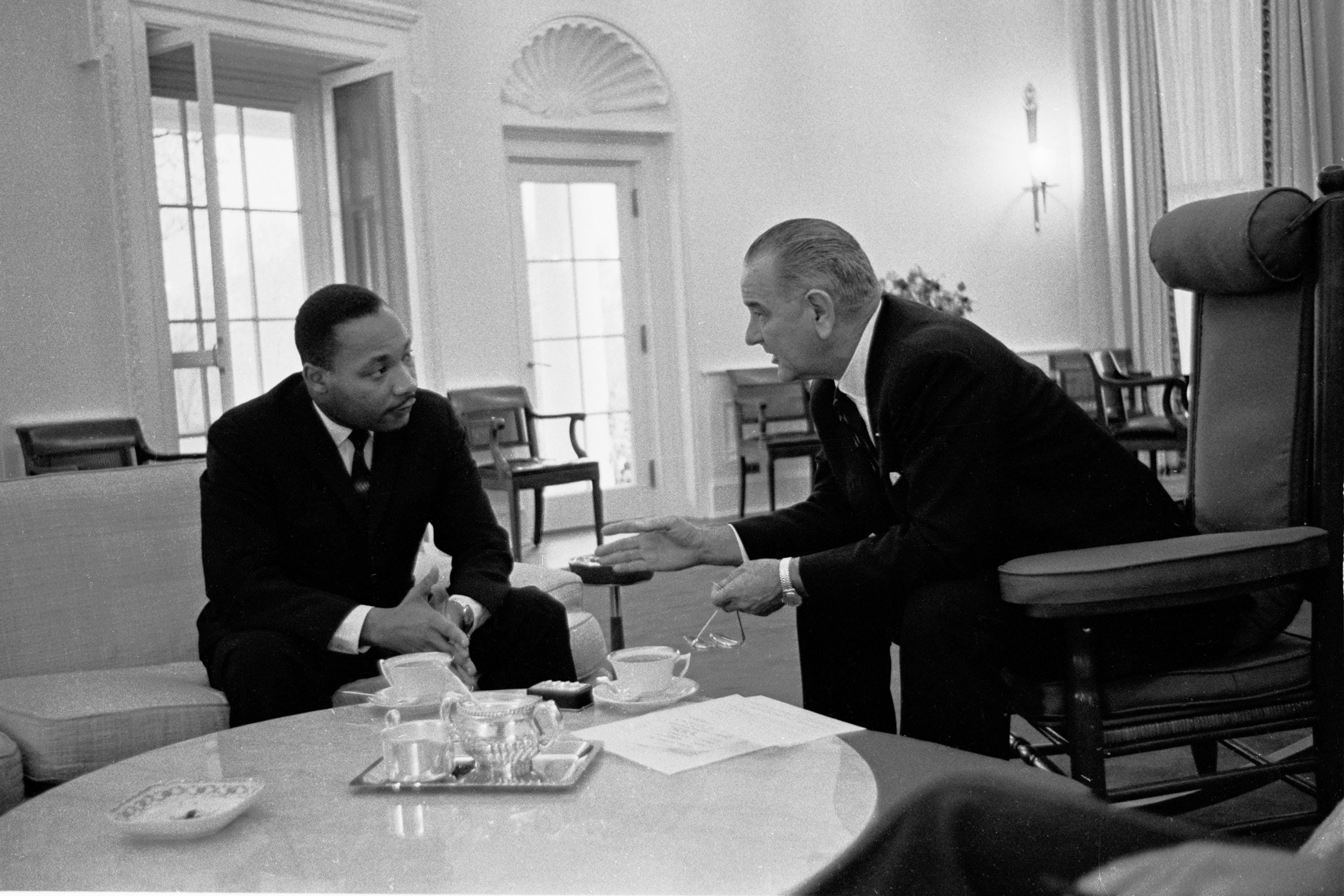

Since Johnson, there has not been another president who embraced his tradition of liberalism. What has happened?
“These days, it seems nobody in America wants to be a liberal — or at least to be called one. For decades, right-wing politicians and media figures have wielded the term as an insult, railing against ‘the liberal media’ and ‘liberal elites.’ By the 1990s, the word had become so toxic that hardly anyone running for office dared embrace it, and Democrats adopted less sullied labels like ‘progressive.’ (Even Barack Obama declined to describe himself as a liberal.)”17
Liberalism once moved mountains. Now it cannot move molehills. The most important reason for its decline is that the great liberal lion Lyndon Johnson was not only a champion of civil rights. He will also forever be associated with the disastrous war in Vietnam. His legacy is permanently tainted. Sadly, and perhaps unfairly, so are his great liberal achievements in domestic affairs.
The truth is that liberalism has an admirable history; and its principles of morality, inclusiveness, and human decency need to be rediscovered and celebrated.
Liberalism could provide the beacon which leads us out of the Trumpian slough of despond.
https://www.washingtonpost.com/opinions/2026/03/24/conservatism-progressivism-liberalism/
https://www.jfklibrary.org/archives/other-resources/john-f-kennedy-speeches/inaugural-address-19610120
Milton Friedman, Capitalism and Freedom (Chicago: University of Chicago Press, 2020) p. 2.
Arthur M. Schlesinger, Jr., The Vital Center (Boston: Houghton Mifflin, 1949; Adrian Wooldridge, The Revolutionary Center (forthcoming on April 21)
https://www.youtube.com/watch?v=XIU9ifRZDhU
https://www.archives.gov/founding-docs/declaration-transcript
Alexander Keyssar, The Right To Vote (New York: Basic Books, 2009)
Helena Rosenblatt, The Lost History of Liberalism (Princeton: Princeton University Press, 2018) p. 156.
Rosenblatt, Liberalism, p. 157.
Rosenblatt, Liberalism, p. 157.
Rosenblatt, Liberalism, p. 230.
Alexis de Tocqueville, Democracy in America (Chicago: University of Chicago Press, 2002). The translation I have used is by Harvey C. Mansfield and Delba Winthrop.
James G. Randall, Lincoln The Liberal Statesman (New York: Dodd, Mead, 1947).
Rosenblatt, Liberalism, pp. 168-175.
Rosenblatt, Liberalism, p. 4.
Lionel Trilling, The Liberal Imagination (New York: New York Review of Books, 1950) Loc. 121.
https://www.nytimes.com/2018/09/14/books/review/james-miller-can-democracy-work.html